I completed my teaching practice at the department of Industrial management, University of Vaasa, during the period of 26.10.2020 – 4.12.2020. During my teaching practice, I taught the course “introduction to production management” for bachelor’s level students. The course was also open to exchange students and master’s students from the department of industrial management, who needs to complete complementary studies.
In this blogpost, I will try to reflect on my teaching practice; specifically I will answer few key questions related to my teaching practice, for example,
- How did I prepared the teaching materials and assessment criteria?
- What was good during my teaching practice?
- What went bad?
- What did I learned?
- What different I would have done during my teaching practice?
In addition, I will bring few feedbacks (both positive and negative) that I received from the students participating the course. Finally, I will conclude this blogpost with my plan for continuous development as a professional teacher.
How did I prepared the teaching materials and assessment criteria?
In response to this question, I would like to start with my teaching philosophy. My teaching practice is a mixture of two pedagogical approach: behaviorism and constructivism. Behaviorism in a sense that I am actively delivering lectures (based on lecture theme supported by teaching materials i.e. power point slides) and constructivism in a sense that student actively needs to take part in actual task, for example numerical calculation and short discussion.
Personally, I believe that teaching and learning experience can be enhanced, if we could change our roles frequently during teaching. In other words, sometimes the teacher is taking the main role and sometimes the students. At the same time, I also believe that each individual has own way of learning, for example, some students learn better by listening to lectures, some learn better by seeing pictures and diagrams while some students learn better through self-study. This is the reason why I follow both behaviorism and constructivism approach in developing the teaching materials. In other words, my teaching material meets the needs of different students, for example, the material is suitable for contact teaching and online teaching. In addition, the materials can be used for self-study, each lecture slides are developed in logical and coherence manner with maximum possible information on the topic. Specifically, when we consider the current time (considering covid-19), the relevance of multipurpose teaching material is very convenient, where both teacher and students are struggling for teaching and learning. I have considered these issues in developing the teaching materials.
I have given two possibility for students to complete the course: Alternative I and II. In alternative I, students have the access to all the teaching materials, do self-study, and take the exam when they are ready. In alternative II, student participate in online teaching, practice exercise, complete the assignments, and finally take the exam.
Key features of my lessons are visual teaching, meaning in my teaching I use power point slides, pictures, and diagrams to explain different concepts, for example. I also use video clips related to the topic under discussion, for example from YouTube. Furthermore, during my teaching I always asks open questions and ask students to take part in discussion. I use all these resources not only to support my teaching, but also to enhancing student’s learning experience.
Similarly, the learning environment can be developed within the scope of classroom or virtual setting. Classroom environment means the traditional way of teaching and learning, where the teacher and student have face-to-face meeting. On the other hand virtual setting means the way of teaching and learning by means of internet, in case of virtual setting students and teacher are connected by means of digital tools, for example, skype, zoom, adobe connect etc. It can be in real time or the as and when needed (different sessions are recorded and can be accessed when needed or at one’s own convenience).
Key steps that I followed in preparing teaching materials
- Curriculum (provided by university administration)
- Syllabus (it’s my work)
- Teaching materials (it’s my work)
- Assessment criteria and course evaluation (it’s my work)
- Lesson plan (it’s my work)
Based on the curriculum provided by the university, I prepared the course syllabus, teaching materials, course implementation plan, assessment criteria and course evaluation, and finally the lesson plan was developed. In order to develop teaching materials I followed above mentioned tasks in a series. To facilitate students learning, Moodle page for the course was developed, where all the teaching materials, course syllabus, implementation plan etc. were available to the course participants.
The development of teaching materials was a bit easy because the course “introduction to production management” comes within my domain of knowledge. I have bachelors of engineering to PhD in industrial management. However, as I was developing the teaching materials, I struggle with time and resources; especially I face challenges to meet the needs of different student’s background, previous knowledge and learning ability. I spent a lot of time in thinking and developing the teaching materials. During the process of developing teaching materials, I realized that lesson planning and developing of teaching materials is one of the most important, crucial, and time consuming. I might have experienced this because I was developing the teaching material and lesson plan independently in my own and for the first time. I hope that by the passage of time I will have different experience.
Assessment criteria
The course contained two sessions for each topic (the course was divided into six different topics), first the normal lecture followed by exercise session. Both lecture and exercise sessions were carried out online through Zoom. During the normal lectures, we talk about the theory within the scope of lecture topic. During the exercise session, we solve the numerical problems related to the lecture themes. In practice, I teach the students how to do different calculations related to production management. Meaning, first I open the numerical questions, ask the students to read it, if there is any difficulties to understand the question I explain them clearly: What information is available in the question and what values needs to be calculated? After this, I give some time to students to do the actual calculation and ask them to send me the answers in the chat box (privately), the exercise sessions were held online. At the end, I demonstrated the solution and explain how the calculation is done, and what does those numbers and calculations means in practice.
At the end students are supposed to submit their calculations, from this student can earn one points for final course evaluation. This extra one point was given not only for course assessment but also to keep students motivation to learn new things throughout the course. Furthermore, students were asked to answer theoretical questions as an assignment after each lecture. However, the assignment following lecture sessions were not the part of course evaluation.
Besides this there was an exam consisting of two parts: Numerical calculations and theory exam. In the exam, students get six different numerical questions, out of which they have to solve five questions. Similarly, in the theory exam, there was two questions, one question with six short questions (out of which student needs to answer four questions) and two essay type questions (out of which student needs to answer one question).
The course was evaluated in the scale of 0 – 5, 0 means fail and 5 means excellent. In order to get excellent grade the student should demonstrate that he/she has good understanding of the course literature and theory, numerical calculation and can apply know-how in practice.
Thus, the assessment criteria was balanced considering numerical calculation, theory, course objective and learning goals.
Either it is guiding students for teaching or doing assessment for grading I do always maintain transparency, for example, I always provide students with clear instruction what they can do and what they cannot do in completing the course. Students have access to all the teaching materials through Moodle. If student do not follow plagiarism guideline in completing the assignments or project work, either they need to re do the task or fail the course. Similarly, students receive clear idea about the criteria for course evaluation at the beginning of the course. If the student is not satisfied with the evaluation, he or she has the right to know how the marking and evaluations has been done. If there come some sort of misunderstanding, the issue is forwarded to administration and the student’s performance will be evaluated by third person, if necessary. Even during my teaching practice one student was willing to go through own exam papers and wanted to know how the markings and evaluations have been made. I was very happy to go through the exam papers with the student.
What went good during my teaching?
24 hours was allocated for contact teaching, 12 hours of lectures and 12 hours of exercise sessions. During my teaching, I tried my best to maintain two-way communication through discussion questions and asking open questions to the students in between the lectures. Students also had an opportunity to ask questions whenever they want. In practice, it was a bit difficult to maintain two-way communication because students do not like to speak. This is quite common in Finland people like to listen rather than speaking, they speak when there is real need to speak; this is what I have experienced. On the other hand, it was a bit different during exercise sessions; students were a bit more open. However, I was confident enough to content, teaching materials and my presentation.
From the pedagogical point of view, I practiced mixed method (behaviorism and constructivism) during the actual teaching and during exercise session, my approach was activity based learning. It was a nice experience to see how student-centered approach and teacher-centered approach work in practice.
What went bad during my teaching?
Each lessons (both lectures and exercise sessions) was planned for 2 hours. Everything worked as planned; I did not experienced any surprises. In some lessons, it was a bit difficult to cover all the materials within two hours of teaching. However, I managed without breaks in the middle but with the permission of students. In some part of teaching, I was too much in the topic and in some part; I was at very surface level. When I look back to my teaching practice, time management during the lecture hours was a bit poor. In many circumstances, during lecture hours, I had difficulties in maintaining two-way communication; very few students were willing to speak. In addition, in some cases I am not satisfied with my presentation skills.
Feedback and comments from the students
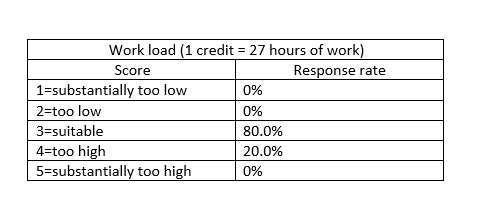
Once the course is over students were asked to give feedback for the course. The feedback was collected through Weeboodi anonymously. Following are the key highlights from student feedback to the course.
Question 1. The course objectives and contents are planned so that 1 credit point corresponds to about 27 hours of student work, including both contact teaching and the student’s independent work. Evaluate the total amount of work that you need to complete the course and, based on that, evaluate if the workload of the course in relation to its credit points is:
Question 2.
| Questions | Average score |
| Overall grade for the course: 1 (weak) – 5 (excellent) | 4.0 |
| Course contents corresponded the intended learning outcomes set for the course: 1 (did not correspond) – 5 (corresponded fully) | 4.0 |
| I took responsibility for my own learning: 1 (scarcely at all) – 5 (full responsibility) | 5.0 |
| I participated actively in the course learning experience (eg. lectures, online assignments, using the material given for the course): 1 (scarcely at all) – 5 (participated fully) | 4.0 |
Question 3. Which factors promoted your learning, what went well?
- Lectures and exercise sessions promoted my learning.
- Exercise and the ability of lecturer to deliver the information.
- Good material in the course and wide field of task and good course book and it was well available.
- Also easy to understand and in numerical exercise lectures there were well time and aid to figure out what was happening and why.
- It is a really interesting course fulfil of useful information, but I would say that it’s a problem if you have the same class with other courses.
Question 4. How would you suggest developing the course in the future?
- Few video presentation and lecture was not recorded.
- The course is perfect enough.
- I would like to suggest recording the classes or lectures next year if the situation continues because some students could have the problem of having the same subject as others at the same time.
- I was happy with it but more do it on your own time tasks with solutions maybe?
When I see the feedback and comments from students, I feel that the course implementation was good. However, there are many things that I would have done differently or have to improve for the future.
What did I learned from my teaching practice?
Before going for actual teaching practice, we had gone through several online teaching sessions as a mandatory part of professional teacher education programme at Oulu University of Applied Sciences. My active participation in all of these sessions helped me a lot not only in preparing for teaching practice but also for actual teaching practice. Key things that I learned during the practice teaching sessions at OAMK are
- How to develop teaching material and assessment criteria?
- How to do course assessment?
- How to handle time management issues during lecture hours?
- How to maintain two-way communication during teaching?
- How to address the need of students (considering special need, background etc.)?
- And few more.
During my actual teaching practice, I experienced myself how all these things (above-mentioned questions) happens in practice. I have practical experience of teaching: before teaching (preparation tasks) and after teaching (course assessment, student feedback and comments). Furthermore, during my teaching practice I noticed few key things, for example,
- Students are more open (for discussion and even for asking questions) in small group in comparison to large group.
- Lesson planning and real implementation are not the same, how well we have planned there comes some challenges during the real implementation.
In the similar manner from my teaching practice I also learned
- to consider students different needs in developing course syllabus or teaching materials or exam. For example, I prepare teaching materials with written supportive documents considering students with busy schedule i.e. work and study, some students prefer to read themselves than coming to regular lecture. At the same time I have also provided an opportunity for the students to take the exam in different dates considering their special need, for example medical reason, military service etc.
- to acknowledge the student’s individuality and the need for support. For example, during my teaching practice few students emailed me that they had difficulties in understanding the topic under discussion. To support these students’ needs I arranged extra lessons other than planned lectures and exercise sessions. During the extra session I tried to understand the reason behind their challenges (e.g. previous background, medical reason, and difficulties with numerical calculations) and I have considered these issues in doing course assessment. In some cases I have provided additional exercise and tasks to promote student’s learning.
- to teach, guide, and assess, the student’s physical, psychical and social safety in mind. For example, I always keep my eyes open while students are having group discussions and make comments to peers. Whenever, I notice something I just interrupt the discussion and make the environment normal. In my teaching I am always try to be friendly, respect my students and the class room environment. In my teaching I always mention that co-operation helps a lot to enhance our learning experience. I am also aware of student’s well-being, safety guidelines provided by the university, there might be someone in the class who needs special attention because of physical or psychological needs, for example.
- to plan teaching and guiding the student’s physical, psychical and social safety in mind. I believe that every person is different and needs some kind of good feelings to promote learning. For example in implementing of my teaching I always try my best not to hurt students physically, psychologically. I always try my best to create a social and friendly environment in the class room whether it is online teaching or contact teaching.
The most important lesson I learned was that we should look for improvement. As a conclusion to this blogpost, I will talk about my continuous learning plan as a professional teacher. Anyway my teaching practice was a nice experience.
What different I would have done during my teaching practice?
Maybe I would have used some recorded video, which might have given a better learning experience to students because they can follow the lecture whenever they want and as many times as they want. There was similar feedback from one the course participant that if the situation (Covid-19) continues he/she recommends producing the recording of the lectures.
I might have practiced flip learning, at least in the first lecture. This is because of the fact that in my teaching, I noticed that some students were facing challenges to understand different terms used this maybe because of the fact that not every student have same background. Maybe, in the future this can be avoided with pre-reading material and assignment before the actual implementation of teaching. Furthermore, it might help me to maintain better two-way communication throughout the course implementation.
Based on the feedback from students, I might have given a bit longer time in completing numerical exercise. In the feedback, one student mentioned, “I was happy with it but more do it on your own time tasks with solutions maybe”. Maybe I have to provide a bit more time for students to complete the numerical exercise.
The assignments following the lectures were optional, maybe in the future I would like to make it mandatory task to pass the course. Instead of optional assignment, mandatory assignment might help students to have a better learning experience. In an informational discussion one of my student mentioned that it would have motivated him to learn better if the assignments after were mandatory.
Based on my experience, I can say that lesson planning and real implementation are not the same, how well we have planned there comes some challenges during the real implementation, for example time management, previous knowledge and background of students (every time student groups are different). However, I believe that for sure proper planning and experience will help to overcome these challenges.
How I have planned to develop continuously as a professional teacher?
Continues development is a constructive philosophy, meaning a person’s understanding and views is not stable it changes with time, experience, and knowledge. This idea is applicable to teachers as well. Thus, to keep up with the needs of current and future students, a teacher should keep on learning continuously.
In the past few decades, the way of teaching and learning has been changed a lot, while I was at high school the way of learning was different from what is happening now. Now students have access to different sources of knowledge and the availability and use of internet has changed our way of learning. Looking at the current situation of education, Covid-19 has really revolutionized current teaching practice throughout the world. The digital competence is must for future teaching. Therefore, as a teacher we should be always open to new knowledge not only on the subject matter but also to new development in teaching and learning style. Furthermore, the continuous and professional development helps a teacher to develop a better learning environment. Therefore, to keep me up dated as a professional teacher I would actively do the following.
- Keep on learning, both the areas of my teaching and development in teaching and learning style. This will help me to keep up-to-date with new development in teaching and facilitating learning.
- Take part in teacher exchange programme. This will help to develop network and to understand different approach of teaching in other culture and community.
- Take part in continuous development courses, workshop and training for teachers. This will help in developing new knowledge and skills to better facilitate the student’s learning.
- Collect and document feedback from student. This will help to evaluate the adopted teaching method, provides reason for improvement, helps to develop and improve teaching methods, and keeps on motivating to learn new things.
- Be familiar with the changes in public policy and laws especially policy and laws related to education. This will help to accommodate changes in course content and curriculum.
- Follow leading international journal in teacher’s education, learning and development. Few leading journals that I have planned to follow are
- Journal of teacher education and educators
- Journal of teacher education
- Teaching and teacher education
- European journal of teacher education
- Australian journal of teacher education
 My Journey to Vocational Teacher Education 2019-20